

From a Tax Professional
2026 Tax Changes: What Hawaiʻi Taxpayers Need to Know Before Filing in 2027
Several federal tax rules changed for the 2026 tax year, and some may affect how much you owe when you file your return in 2027. From deductions for qualifying tips and overtime to updated standard deductions and child tax credits, it is worth reviewing what's new before the year ends.
At MahinaBeam Bookkeeping & Taxes in Hilo, I help individuals and business owners make sense of their records and prepare for filing season. Here are the 2026 highlights I want taxpayers to know about.
1. The 2026 standard deduction is higher
For federal income tax returns covering 2026, the standard deduction is:
Filing status | 2026 standard deduction
Single or married filing separately | $16,100
Married filing jointly | $32,200
Head of household | $24,150
The standard deduction reduces the income subject to federal income tax. Whether you should take it or itemize depends on your eligible deductions and filing situation.
2. Qualifying tip income may be deductible
Eligible workers in occupations that customarily and regularly receive tips may be able to deduct up to $25,000 of qualified tip income each year for 2025 through 2028. The deduction has reporting and eligibility requirements and begins to phase out above $150,000 in modified adjusted gross income, or $300,000 for joint filers. Qualified tips generally must be voluntary and properly reported. This is a federal income tax deduction, not a blanket exemption from every type of tax.
3. There is a new deduction for qualifying overtime pay
The overtime deduction can cover the extra premium portion of qualified overtime compensation, not the entire overtime paycheck. For example, where eligible overtime is paid at time-and-a-half, the additional "half" portion may count. The maximum annual deduction is $12,500, or $25,000 for married couples filing jointly, subject to income limits and reporting rules.
4. Some new vehicle loan interest may qualify for a deduction
For eligible personal-use vehicles bought new after December 31, 2024, taxpayers may deduct up to $10,000 a year in qualifying auto loan interest for 2025 through 2028. The vehicle must meet requirements including final assembly in the United States. The deduction does not apply to leases, and it phases out at higher incomes. If you purchased a vehicle, keep your loan-interest records and the vehicle identification number (VIN).
5. Taxpayers age 65 and older may qualify for an additional deduction
An eligible individual age 65 or older may claim an additional federal deduction of up to $6,000 for 2025 through 2028, or up to $12,000 for a married couple if both spouses qualify. It begins to phase out above $75,000 in modified adjusted gross income, or $150,000 for joint filers.
You may have heard that Social Security is now tax-free. That is not quite right. This additional deduction can reduce federal income tax for some seniors, but Social Security benefit taxation still depends on the taxpayer's overall income and other rules.
6. The Child Tax Credit may be worth up to $2,200
For 2026, the federal Child Tax Credit is worth up to $2,200 for an eligible child under age 17. Up to $1,700 may be refundable through the Additional Child Tax Credit, subject to requirements including at least $2,500 in earned income. Income limits, relationship and residency tests, and identification requirements also apply. A separate $500 Credit for Other Dependents may apply in certain cases.
7. Cash donations may help even if you do not itemize
Beginning with 2026 returns, eligible taxpayers who do not itemize may deduct up to $1,000 in qualifying cash contributions, or $2,000 for married couples filing jointly, made to eligible charitable organizations. Keep donation receipts and bank records. Noncash donations do not qualify for this particular non-itemizer deduction.
8. Health Savings Account contribution limits increased
For 2026, the regular HSA contribution limits are $4,400 for eligible self-only high-deductible health plan coverage and $8,750 for eligible family coverage. Special rules, including eligibility, partial-year coverage and catch-up contributions for those age 55 or older, may affect your individual limit.
9. Federal tax brackets shifted for 2026
The federal marginal tax rates still range from 10% to 37%, but the taxable-income cutoffs have increased for inflation. For example, the 12% bracket begins above $12,400 for single filers and above $24,800 for married couples filing jointly. Because brackets are marginal, moving into a higher bracket does not mean all of your income is taxed at that rate. You can review the full tax tables on the IRS website.
Mortgage interest on a qualified primary or secondary residence may still be deductible for eligible taxpayers who itemize, subject to applicable limits.
10. Hawaiʻi disaster losses deserve a closer look
Hawaiʻi experienced several major disasters during 2026, including the March Kona Low storms, the May 22 Hawaiʻi Island earthquake, Hurricane Lala and Hurricane Lowell. Some uncompensated property losses connected with qualifying declared disasters may be eligible for federal tax treatment. Beginning in 2026, certain state-declared disaster losses can also qualify for personal casualty loss deductions, subject to specific limits.
If you experienced damage, keep records of repair costs, photographs, insurance claims, reimbursements and any relevant disaster declarations. Not every storm-related expense automatically qualifies for a deduction.
11. An important note about residential solar credits
If you are considering a residential solar installation, be aware that the federal Residential Clean Energy Credit generally does not apply to installations completed after December 31, 2025. Certain unused credits from earlier qualifying years may be carried forward. This distinction is especially important when reviewing lists of possible tax documents and expenses.
Get your 2026 tax records together now
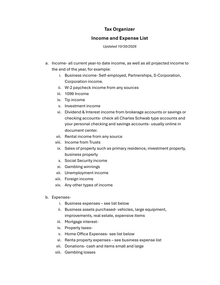
Free Printable Income & Expense Tax Organizer
 PDF
Before filing season, collect your W-2s, 1099s, business income and expense reports, mortgage interest, charitable donation records, and information about any potential credits or deductions. Business owners should also review bookkeeping, payroll, large purchases, loan interest and Hawaiʻi GET filings.
I've put together a printable Income & Expense Tax Organizer to help you identify which records to gather. The checklist is a starting point, not a list of deductions everyone is entitled to claim.
I've put together a printable Income & Expense Tax Organizer to help you identify which records to gather. The checklist is a starting point, not a list of deductions everyone is entitled to claim.
A final reminder:
This article discusses federal tax rules. Hawaiʻi income-tax treatment may differ, and eligibility depends on your circumstances. Please consult a qualified tax professional before relying on any particular deduction or credit.
Sources and further reading
- IRS, Working Families Tax Cuts for Individuals and Workers: https://www.irs.gov/newsroom/working-families-tax-cuts-individuals-and-workers
- IRS, Child Tax Credit: https://www.irs.gov/credits-deductions/individuals/child-tax-credit
- IRS, 2026 HSA limits: https://www.irs.gov/irb/2025-21_IRB
- IRS, Publication 505 (2026): https://www.irs.gov/publications/p505
- IRS, 2026 disaster casualty-loss treatment: https://www.irs.gov/newsroom/wildfire-relief-payments-and-casualty-losses-frequently-asked-questions
- IRS, Home energy credit expiration: https://www.irs.gov/newsroom/faqs-for-modification-of-sections-25c-25d-25e-30c-30d-45l-45w-and-179d-under-public-law-119-21-139-stat-72-july-4-2025-commonly-known-as-the-one-big-beautiful-bill-obbb
- Office of the Hawaiʻi Governor, September 23, 2026 disaster report: https://governor.hawaii.gov/newsroom/office-of-the-governor-news-release-hawai%CA%BBi-faces-approximately-1-billion-in-disaster-recovery-and-resilience-needs/

Get your taxes done right.
Maximize your tax savings with my expert preparation and filing services. I'll help you find every deduction and credit you're entitled to, so you can keep more of your hard-earned money.